
Chain Bridge (Széchenyi Lánchíd) — Budapest's Iconic Crossing
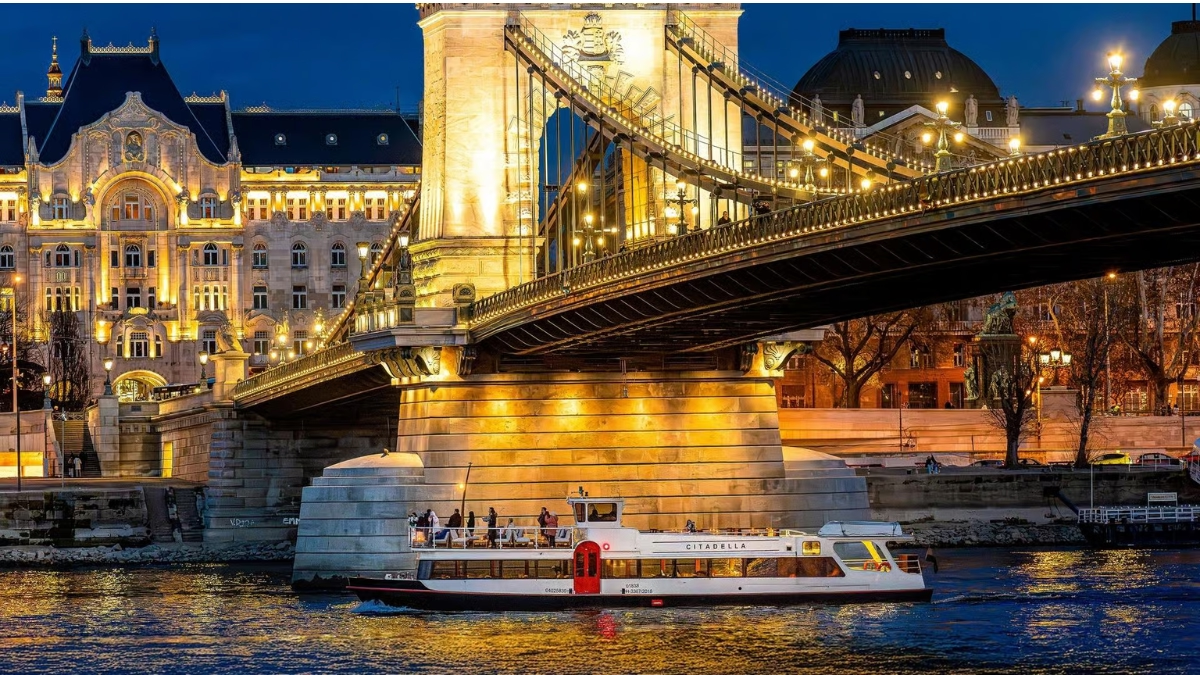
The Széchenyi Chain Bridge (Széchenyi Lánchíd) is Budapest’s most famous and oldest permanent bridge, opened in 1849. It connects Széchenyi István tér on the Pest side with Clark Ádám tér on the Buda side, directly below Buda Castle. Designed by English engineer William Tierney Clark and built under Scottish engineer Adam Clark, it was the first permanent river crossing between Buda and Pest. At 375 metres long with a central span of 202 metres, it was one of the longest suspension bridges in the world at the time of its completion. From a Danube cruise, the Chain Bridge is the centrepiece of the river view — its stone towers, illuminated chains, and four stone lions visible from every point on the water.
The Chain Bridge is Budapest’s most recognisable symbol — older than the unified city itself, destroyed in war, rebuilt in its centenary year, and still the centrepiece of every Danube river cruise today. This guide tells its full story and explains what you see when you pass it from the water.
Chain Bridge Budapest — History and Origin
Count Széchenyi’s Vision
The story of the Chain Bridge begins with a personal frustration. In December 1820, Count István Széchenyi — later known as “the Greatest Hungarian” — rushed from Debrecen to Vienna on hearing news of his father’s death. He was stranded for a week on the Buda side of the Danube, unable to cross because winter ice had made ferry crossings impossible. That delay crystallised a determination: Budapest needed a permanent bridge.
In 1836, Széchenyi commissioned English engineer William Tierney Clark to design it. Construction began in 1839 under the on-site supervision of a different engineer, Scottish-born Adam Clark (the two Clarks were unrelated). The central Budapest square at the Buda end of the bridge is named after Adam Clark, the man who built it.
Construction and Opening
Building the bridge was a major engineering undertaking. The central span of 202 metres was one of the longest in the world at completion. The bridge sections were designed in Britain and shipped to Hungary for assembly. In the summer of 1848, a construction accident swept Széchenyi himself and some workers into the Danube — he escaped, but a worker died. The 1848–49 Hungarian Revolution slowed construction further. In May 1849, the Austrian General Hentzi attempted to blow up the bridge to prevent it from aiding the Hungarian forces — but the explosion failed. The bridge opened to traffic on 20 November 1849, inaugurated by the Austrian general who had suppressed the Hungarian revolution. Széchenyi, by then mentally broken, never walked across it.
Destruction and Rebuilding
In 1849 the Austrian army unsuccessfully tried to destroy it. Nearly a century later, in January 1945, the retreating German forces succeeded — the Chain Bridge was blown up during the Siege of Budapest along with every other bridge across the Danube. It was rebuilt and reopened in 1949, its centenary year, carefully replicating the original design including the towers, the chains, and the four stone lions.
The Lion Legend
The four stone lions at the bridge’s abutments — carved by sculptor János Marschalkó and installed in 1852 — have become as famous as the bridge itself. A persistent Budapest legend claims that the lions have no tongues. Contemporary accounts suggest that at the unveiling, a chimney sweep shouted from the crowd that the sculptor had forgotten to give the lions tongues — leading to such mockery that Marschalkó is said to have drowned himself in the Danube in shame. Closer inspection reveals that the lions do in fact have tongues, just not visible from ground level. The legend endures.
Chain Bridge — What You See from a Danube Cruise
From a Danube cruise, the Chain Bridge presents a completely different spectacle depending on the time of day.
By day, the stone towers and the pale ironwork of the suspension chains stand out cleanly against the sky. The four lions at the abutments are clearly visible — one at each corner of the bridge. On the Buda side, the castle funicular rises directly behind the bridge’s western tower, and the imposing mass of Buda Castle fills the hilltop above.
By night, the bridge transforms. The stone towers are floodlit in white; the suspension chains are traced in amber; the lion statues cast long shadows. On a calm evening, the entire illuminated bridge reflects on the river below in a perfect mirror image.
The bridge connects Széchenyi István tér on the Pest bank — where the Hungarian Academy of Sciences and the Four Seasons Gresham Palace face the river — with Clark Ádám tér on the Buda bank, directly at the base of the castle funicular. Every city cruise passes the Chain Bridge on both northward and southward legs.
The Chain Bridge Budapest Today
The Chain Bridge was closed for a major renovation between March 2021 and August 2023, its most comprehensive restoration since reconstruction in 1949. It has since reopened to traffic and pedestrians. Walking across the Chain Bridge is one of the classic Budapest experiences — a 10-minute stroll with extraordinary views in both directions.
Frequently Asked Questions
When was the Chain Bridge built?
The Chain Bridge was completed in 1849, making it the first permanent bridge to connect Buda and Pest. Its construction was championed by Count István Széchenyi, after whom it is officially named.
Was the Chain Bridge destroyed during World War II?
Yes, all of Budapest’s bridges were destroyed in 1945 as German forces retreated. The Chain Bridge was rebuilt and reopened on 20 November 1949, marking exactly 100 years since its original opening.
Can you walk across the Chain Bridge today?
Yes, the Chain Bridge is open to pedestrians and is one of Budapest’s most popular walking routes. The 375-meter crossing takes about 5–10 minutes on foot and offers panoramic views of the Danube and both banks.
What will I see from a Danube cruise passing under the Chain Bridge?
From a river cruise, you’ll see the bridge’s iconic stone towers frame the cityscape, with Buda Castle visible on the Buda side and Parliament Building on the Pest side. It’s one of the most photographed perspectives of Budapest.
Why is it called the ‘Chain’ Bridge?
The bridge is named after its suspension system of iron chains that support the main span. This innovative chain suspension design was remarkably advanced engineering for the 1840s.
What are the lion statues at the Chain Bridge?
Each entrance to the bridge is guarded by a pair of limestone lion sculptures created by János Marschalkó. These iconic lions have become one of Budapest’s most recognizable symbols.
